
Technical Reference
Shelter Systems and Capabilities
Most shelter marketing lists features. This page explains the engineering behind them, the variables that drive cost, and how we verify that what was specified is what was actually built. If you already know this material, you will see quickly whether we do. If you are new to it, this is the honest version.
Hardened Structures Technical Discipline
A shelter is engineered as a system.
Structure, openings, air, water, power and habitability have to work together — then be tested before turnover.
System 01
Everything Starts With the Envelope
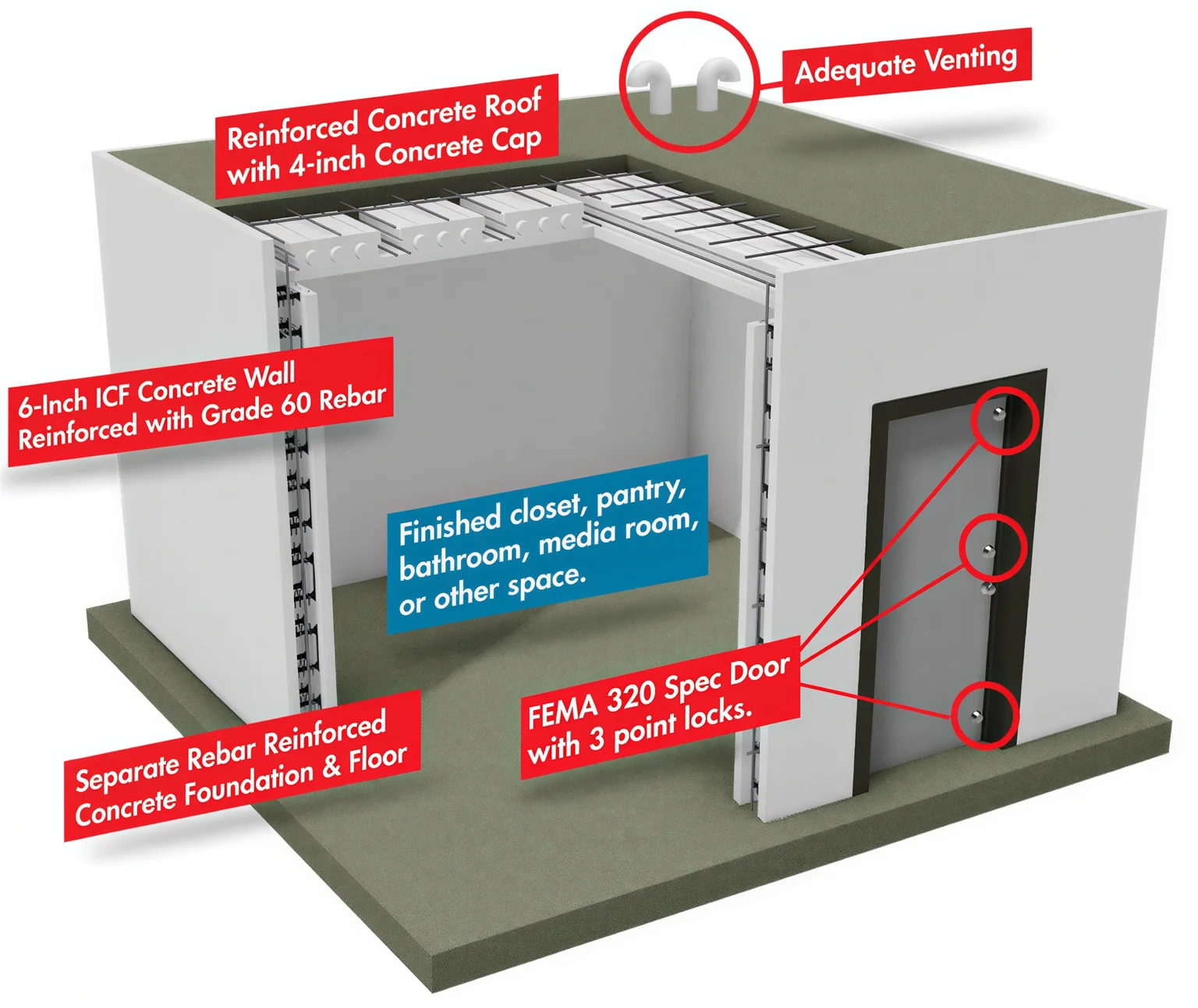
A shelter is a pressure boundary, not just a strong box. Filtration only protects you if the structure holds the slight positive pressure the filtration system creates — otherwise contaminated air seeps in through gaps faster than the filters can clean it.
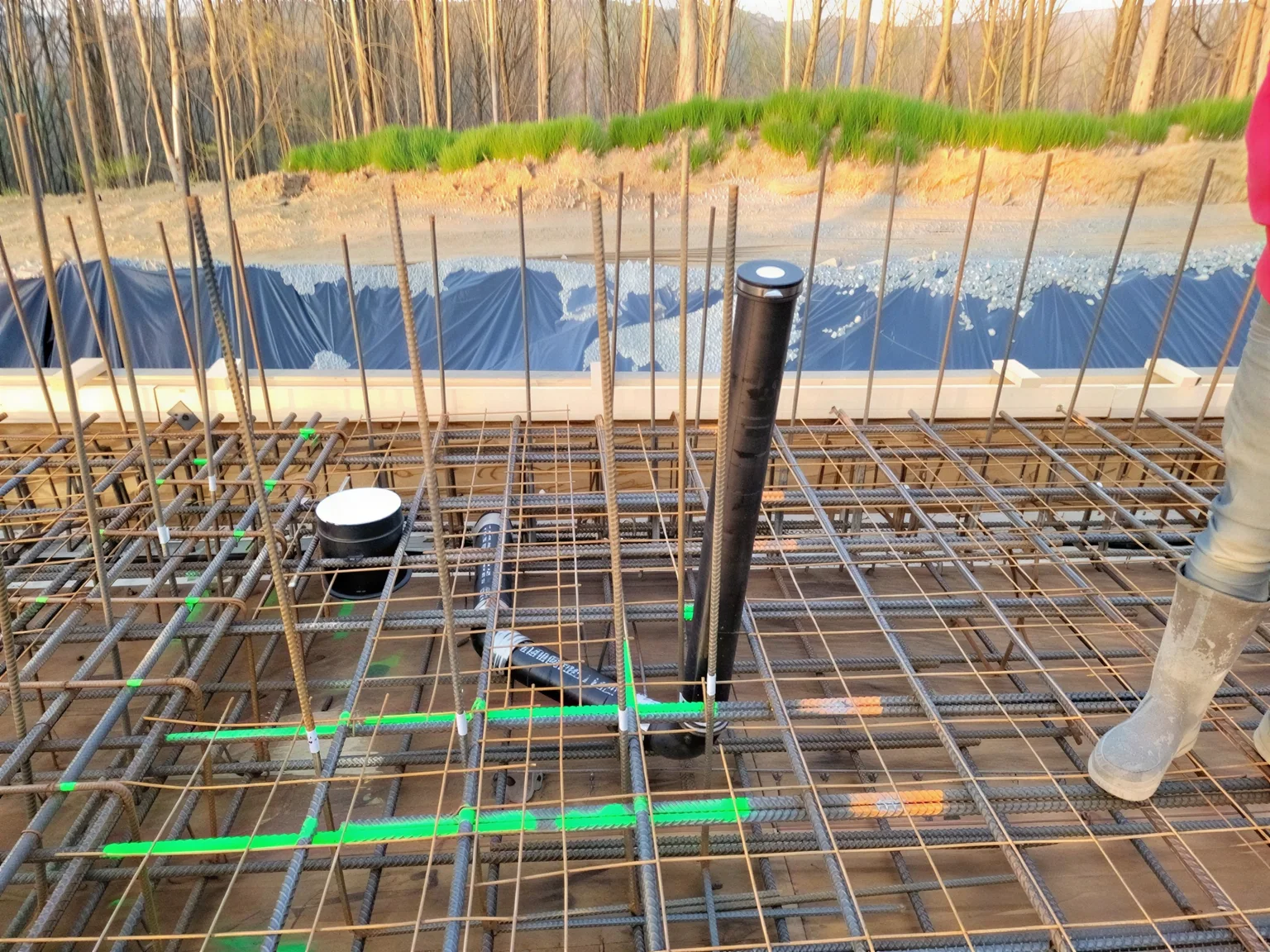
That makes airtightness a structural requirement, not a finishing detail. It is set by decisions made early: continuity of the concrete, how construction joints are treated, and above all how every service crossing the boundary is detailed. Conduit, water, waste, ventilation, communications, drains — each is a leak path, and each has to be a cast-in gas-tight sleeve, sealed and tested. Cored later, they are compromises.
We build the envelope first and verify it by pressure test before any system is commissioned. Our background in high-performance residential construction, including Passive House methodology, is the same discipline applied to a harder target: continuous air barrier, detailed penetrations, quantitative testing rather than visual sign-off.
“A filter fitted to a leaky shelter filters air that is bypassing you.”
System 02
CBRN Air Filtration and Overpressure
A collective protection system draws outside air through staged media and delivers it to the protected space at positive pressure.
Sizing is driven by occupancy, duration and activity level, not by picking a unit from a catalogue. Those numbers come from the engineer of record and are stated in your documents.
- —Prefilter — removes coarse particulate and protects the stages behind it.
- —HEPA stage — captures radioactive fallout particles, dusts and biological agents.
- —Impregnated activated carbon — adsorbs chemical agents and vapours. Carbon has a service life and a shelf life; both are specified and both are scheduled.
- —Overpressure — the system maintains the interior above ambient so leakage runs outward.
- —Blast valves — fast-acting closures on intake and exhaust that shut against a pressure wave and reopen, protecting both the occupants and the filter media.
- —Manual operation — a system that requires power is a system that fails in the scenario it was bought for. Hand-crank or manual backup capability is specified as standard.
System 03
Decontamination Entries
Where the planning scenario includes entry after exposure, the entry is designed as a sequence rather than a door: a dirty-side zone for removing outer clothing and equipment, a wash and transition stage, and the clean protected space — with air pressure cascading from clean to dirty so airflow always runs the correct direction, and with effluent handled rather than tracked.
It costs footprint, mechanical complexity and money. It is specified deliberately against a stated scenario, or not at all.
System 04
Water Supply, Storage and Treatment
Three layers, specified together:
Worth understanding plainly: fallout is particulate, and water affected by fallout is generally treatable by filtration. That is a different engineering problem from a dissolved chemical contaminant, and the treatment train is specified for the threat, not for the brochure.
- —Storage — potable water sized to occupancy and planned duration, in appropriate tankage with turnover and treatment provisions.
- —Independent source — typically a deep well with a manual pump that functions with no power at all, alongside the powered system.
- —Treatment — sediment and carbon stages, a disinfection stage such as UV or chemical, and reverse osmosis where the source demands it.
System 05
Power and Long-Duration Habitability
Independent power sized to the actual load — filtration, water, lighting, refrigeration, communications — with storage and generation matched to the planned duration, and hardened against EMP where that is part of the specification.
The problem that gets underestimated underground is moisture. Buried concrete sits against ground at a constant low temperature, and warm occupied air against a cold surface condenses. Left unmanaged it degrades stored goods, finishes, air quality and morale over exactly the durations a shelter is built for. Continuous insulation, dew-point control, ventilation strategy and dehumidification are designed together rather than bolted on. This is the least glamorous part of shelter engineering and the part that determines whether a space is habitable for weeks.
System 06
Ratings, and What They Actually Mean
Ballistic. UL 752, Levels 1 through 10. Level 5 stops a single 7.62mm NATO round; Level 8 stops sustained fire. Reinforced concrete at shelter thickness exceeds Level 8 inherently, so the ballistic specification is really about doors, glazing and hatches. The room is rated at its weakest element.
Blast. Expressed as peak overpressure in psi or bar. One bar is roughly fifteen psi and is a common private-shelter design point. Peak alone is incomplete — duration and impulse matter as much, ground shock governs below grade, and openings set the real rating. A shell rated to three bar with a one bar door is a one bar shelter.
Radiation. Protection factor is a function of mass and geometry. Concrete and soil attenuate gamma radiation predictably, and every additional increment of thickness buys another halving of dose. Depth of cover, wall thickness and the geometry of the entry all contribute, and entry geometry is often the weak point — a straight shaft admits radiation that an offset one does not.
We state what a structure is engineered to, and we state plainly when it is a hardened buried shelter rather than a blast-rated one. That distinction is the fastest way to tell a serious builder from a salesman.
System 07
EMP, HEMP and Geomagnetic Disturbance
Two different problems, routinely conflated.
Geomagnetic disturbance — a solar event inducing slow currents in long conductors. It threatens the power grid, not the electronics in your pocket. The answer is independence: generation, storage, water and fuel that do not depend on the grid.
High-altitude EMP — a nuclear burst producing a fast pulse that couples into short conductors and can destroy small electronics directly. The answer is shielding: a conductive envelope, filtered power and data penetrations, treated ventilation openings, and gasketed doors, verified by measurement.
They are separate scopes with separate costs. A shielded box with no power source is as useless as a generator with no shielding. Anyone offering "EMP protection" without distinguishing them has not done the work.
System 08
How We Prove It
Specification is easy. Verification is the difference.
You should ask any shelter builder for that last item before you sign anything. If they cannot describe it, you have your answer.
- —Independent special inspection of concrete placement, mix design and reinforcing.
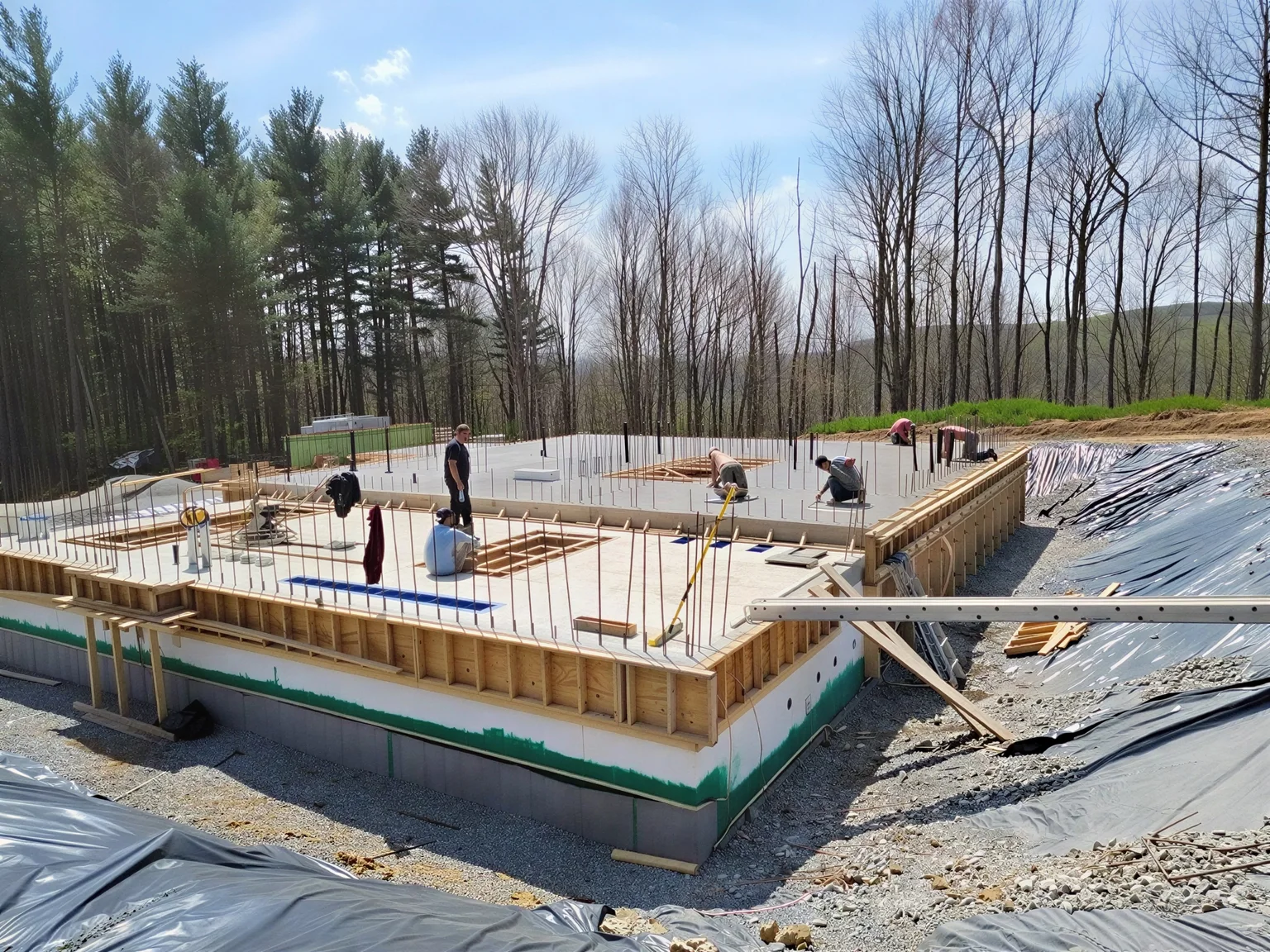
- —Geotechnical observation of excavations before steel is placed.
- —Envelope pressure testing before systems commissioning.
- —Documented commissioning of every mechanical system against its design criteria.
- —A turnover package recording what was specified, what was installed, what was tested and what it achieved.